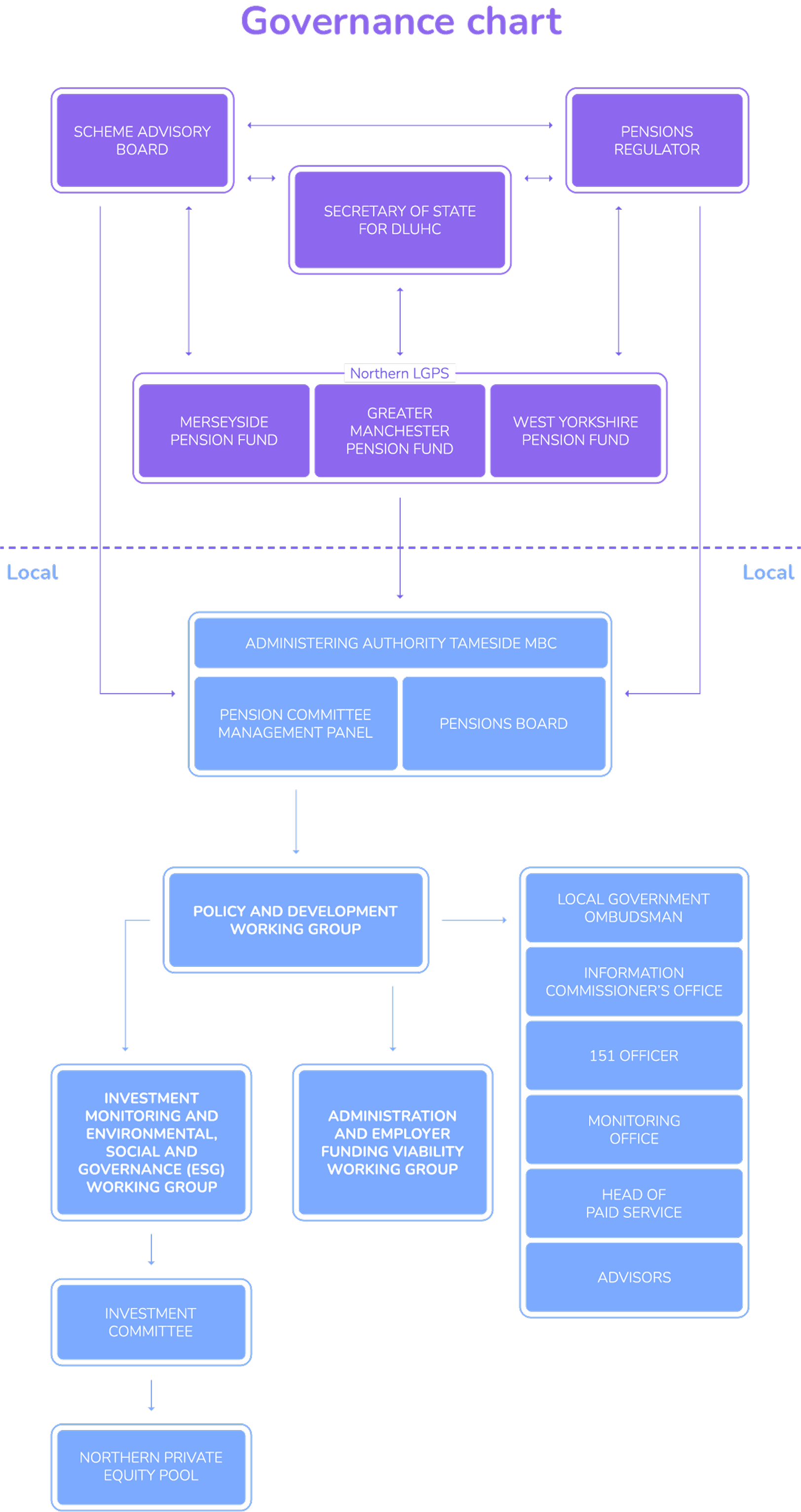
Overview Of Gmpfs Governance Structure
Overview of GMPF’s Governance Structure
The LGPS regulations 2013 are the main regulations that set out how the LGPS must be run. Tameside Metropolitan Borough Council (TMBC) is listed as an administering authority in these regulations and so is required to maintain GMPF.
Administering Authority
The regulations state that an administering authority is responsible for managing and administering the LGPS for any person for which it is the appropriate administering authority under the regulations. The regulations also say how the administering authority must govern the pension fund.
An administering authority may delegate any function under the regulations, including this power to delegate. It would be regarded as appropriate for it to delegate some or all its responsibilities to a Pension Committee/Panel or subcommittee, and some of its responsibilities to officers. However, it would not usually be appropriate for it to delegate all its responsibilities to officers. TMBC’s constitution sets out how TMBC has chosen to exercise its powers of delegation.
- In accordance with the decision of the Association of Greater Manchester Authorities on 19 December 1986, the Council established a Committee to which are delegated the functions vested in the Council by virtue of the Order made by the Secretary of State for the Environment pursuant to Section 67 of the Local Government Act 1985.
- The Committee, called the GMPF Management Panel, shall comprise 16 Members, of which 11 Members shall be Tameside Councillors and five co-opted by Tameside on the recommendation of the remaining nine Districts acting through the Association of Greater Manchester Authorities.
- The GMPF Management Panel shall appoint a Pension Fund Advisory Panel comprising one elected Member, appointed by each of the District Councils, and six employee representatives; provided that any such employee representative shall not be an employee of the administering authority whose employment responsibilities involve any aspect of administration of the GMPF.
- The Pension Fund Advisory Panel shall have the following duties:
- Advise on the establishment of policies in relation to investment management, including the appointment and approval of Terms of Reference of independent advisers to GMPF and investment managers;
- The monitoring of investment activity and the performance of GMPF;
- The oversight of the administrative and investment management functions of GMPF; and
- The giving of advice and guidance to Officers in the exercise of delegated powers.
- Scheme of Delegation to Officers – The GMPF Management Panel has approved a Scheme of Delegation to the Director of Governance, Resources and Pensions in respect of (i) Benefits and Contributions and (ii) Investment Matters (set out in part 3(a) Section 15(g) of the Constitution).
The administering authority is responsible for maintaining and administering its LGPS fund. It makes all the decisions relating to the fund’s operation. Its key tasks include:
- Calculating and paying benefits to pension fund members and dependants
- Collecting employee and employer contributions from fund employers
- Investing the contributions collected and looking after the fund’s assets
- Setting an investment strategy, including determining the fund’s allocation to different asset classes
- Making admission agreements with new employers who want to join
- Preparing, maintaining and publishing a funding strategy statement
- Setting the contribution rates that employers must pay, which is done in conjunction with its actuary
The administering authority does not normally determine the entitlement to benefits for pension scheme members; this is usually the responsibility of a scheme member’s employer. And although it is responsible for investment strategy, the investment pool (Northern LGPS) is responsible for managing investments day-to-day.
The administering authority’s chief finance officer (section 151 officer) is responsible for the financial administration of the fund and must ensure there is an effective system of internal financial control in place.
Since April 2018, the Government has required LGPS pension funds to pool investments. There are eight investment pools across England and Wales. GMPF is part of the ‘Northern LGPS’, together with Merseyside Pension Fund and West Yorkshire Pension Fund.
The Management Panels or Committees of each pension fund continues to be responsible for setting objectives, beliefs and their fund’s strategic allocation. However, the responsibility for manager selection has largely passed to the investment pool.
MHCLG is the ministerial department in charge of overseeing local government and the LGPS. Their overall aim is to ‘…create great places to live and work and to give more power to local people to shape what happens in their area.’ MHCLG are responsible for the LGPS regulations and produce guidance on all the issues impacting the LGPS, for example the pooling of LGPS investments or ill health benefits.
The MHCLG has a useful website and all of the LGPS regulations can be found on their website.
The Local Government Pension Scheme Advisory Board (SAB) is a body set up under Section 7 of the Public Service Pensions Act 2013 and the LGPS Regulations 110-113.
The purpose of SAB is to both react to and review issues affecting the LGPS. It will seek to encourage best practice, increase transparency and coordinate technical and standards issues. The SAB acts as an intermediary between government and the LGPS considering items passed to it from the Ministry for Housing, Communities and Local Government (MHCLG) on issues such as calculating the pensions cost cap and offering opinions on consultations. The SAB will make recommendations to government to bring about beneficial changes to the LGPS. Its key responsibilities include:
- Seeking to encourage best practice across all LGPS funds and raise standards
- Providing advice to the Secretary of State on the desirability of scheme changes
- Providing advice to Local Pension Boards and to scheme managers on effective and efficient administration
- Working to increase transparency
SAB must submit a budget and work programme to the Secretary of State each year for approval. Once approved, the budget for SAB is funded through a statutory levy on LGPS administering authorities. This levy is classed as an administration expense and can be recharged to the pension fund.
The Pensions Regulator (TPR) is the UK regulator of workplace pension schemes. Its key role is to oversee the governance and administration of the LGPS.
TPR works with employers and those running pensions to ensure compliance so that people can save safely for their retirement. TPR are sponsored by the Department for Work and Pensions (DWP).
- making sure employers put their staff into a pension scheme and pay money into it (known as ‘automatic enrolment’)
- protecting people’s savings in workplace pensions
- improving the way that workplace pension schemes are run
- reducing the risk of pension schemes needing the Pension Protection Fund (PPF)
- making sure employers balance the needs of their defined benefit pension scheme with growing their business
- Issuing codes of practice covering aspects of administration and governance.
TPR does not get involved in individual pension disputes that a member might have with their pension scheme. These are dealt with by the Pensions Ombudsman.
TPR produces codes of practice that provide practical guidelines on how to comply with the legal requirements of pension’s regulation. The codes of practice show how to report breaches, report late payment of contributions to pension schemes, how to operate effective internal controls and much more. Code of practice number 14 gives a good overview of the governance and administration necessary for pension schemes.
TPR requires pension funds to record all breaches of the law on all occasions, even if they are not likely to be materially significant to The Pensions Regulator.
The Local Pension Board
The administering authority must determine the membership of their local board, how members are appointed and removed and the terms of appointment. There must be an equal number of employer and member representatives, each of which must have the capacity to represent either employers or members, respectively.
Members of the Local Pension Board must have the necessary knowledge and understating to carry out their functions, as required by Section 248A of the Pensions Act 2004.
The Regulations require each administering authority to establish a local pension board to assist to:
Regulatory Compliance
Securing compliance with the regulations, any other legislation relating to the governance and administration of the Scheme, and requirements imposed by the Pensions Regulator in relation to the Scheme.
Effective Scheme Governance
Ensuring the effective and efficient governance and administration of the Scheme.
The Management & Advisory Panel
What is the Management Panel?
The Management Panel is the main committee responsible for GMPF’s strategic decision making. The Panel has its powers delegated to it from the Administering Authority in accordance with S101 of the Local Government Act 1972. The Panel decides on investment strategy, funding strategy, pension administration strategy and more.
The Working Groups feed into the Management Panel and provide recommendations, but the decision-making power lies with Management Panel.
The Management Panel consists of up to 23 trustee members, as follows:
- Up to 13 Tameside MBC councillors
- One representative of the Ministry of Justice
- 9 councillors co-opted by TMBC on recommendation of the 9 Districts acting through the Association of Greater Manchester Authorities
The Panel appoints its own Pension Fund Advisory Panel to aid its work.
What is the Advisory Panel?
The Advisory Panel, as the name suggests, advise Management Panel. They have limited voting rights and serve as an auxiliary support to the main Management Panel. The Management Panel and Advisory Panel are part of dual meetings where both panels meet at the same time.
The Advisory Panel comprises of one elected Member, appointed by each of the Greater Manchester Councils, and six employee representatives selected from Unite, Unison and GMB.
The Pension Fund Advisory Panel has the following duties:
- Advise on the establishment of policies in relation to investment management, including the appointment and approval of Terms of Reference of independent advisers to the Fund and investment managers
- Monitoring of investment activity and the performance of the Fund
- Oversight of the administrative and investment management functions of the Fund
- Giving of advice and guidance to Officers in the exercise of delegated powers.
The Working Groups
Administration, Employer Funding & Viability Working Group
The Administration, Employer Funding and Viability Working Group (AEFVWG) provide in-depth review and scrutiny of administration matters. AEFVWG receive routine items about a range of administration workstreams such as GMPF member services, progress on communications and engagement, employer services, and development updates.
AEFVWG feeds into Management Panel and contributes knowledge on administration matters. Membership of AEFVWG is drawn from the members of the Management and Advisory Panels, and is chaired by a TMBC Councillor.
Investment Monitoring, & Environmental, Social & Governance Working Group
The Investment Monitoring, and Environmental, Social and Governance Working Group (IMESGWG) support Management Panel with in-depth reviews of investment performance monitoring and receive detailed information on GMPF’s ESG impacts. PIRC (GMPF’s responsible investment advisors) and the various fund managers present their advice and performance at this Working Group.
Membership of IMESGWG is drawn from the members of the Management and Advisory Panels, and is chaired by a Tameside MBC Councillor.
Policy & Development Working Group
Policy and Development Working Group consider changes to GMPF’s policy and approach. P&D aid Management Panel in considering GMPF’s strategic direction and approach. P&D help consider changes to GMPF’s investment strategy and asset allocation before being presented to Management Panel.
Membership of P&D is drawn from the members of the Management and Advisory Panels, and is chaired by a Tameside MBC Councillor.