Our approach to responsible investing
There are lots of types of investment. You can group investments under different headings known as ‘asset classes’. Greater Manchester Pension Fund (GMPF) invests in these asset classes : public equity, bonds, cash, property & alternative assets.
Businesses have several options for raising capital and attracting investors. Equity allows a company to give investors a share of the business. The investor then earns returns as the business grows. Most publicly traded stocks are available and easily traded daily through public market exchanges, such as the London Stock Exchange.
A bond gives a fixed rate of return. A bond could be thought of as an ‘I owe you’ between the lender and borrower that include the details of the loan and its payments. Bonds are used by companies and governments to finance projects and operations.
An alternative investment is a financial asset that does not fall into one of the conventional investment categories such as stocks, bonds and cash. Types of alternative investment include private equity and real estate. Since July 2018, we have invested in private equity through our Northern LGPS joint venture arrangement, Northern Private Equity Pool LP. You can find more information about this on the Northern LGPS website.
The returns that we get on our investments help to pay towards the cost of pensions. If we didn’t invest, contributors and employers would have to pay more than twice as much as they do now in order to get the same level of pension benefits. Investing also has the additional benefit of being good for the local and wider economy.
We appoint external investment managers to invest the majority of our assets on our behalf. These managers invest according to the guidelines set by our management panel.
We manage some investments internally. This is mainly through a joint venture called GLIL Infrastructure LLP. We also purchase and manage some properties directly through the Greater Manchester Property Venture Fund, and we have a Local Investments Impact Portfolio.
GLIL Infrastructure LLP (GLIL) is a joint venture created in April 2015 by GMPF and Local Pensions Partnership to invest directly into infrastructure assets, predominantly in the UK.
Since then, GLIL has committed over £1.8 billion from five Local Government Pension Scheme (LGPS) funds and is looking to engage collaboratively with other pension schemes.
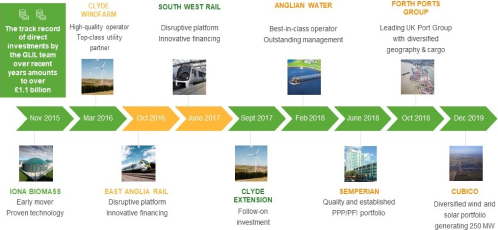
GLIL has completed nine transactions to date in the energy, transport, utilities and social infrastructure sectors. These nine transactions represent an investment of over £1.1 billion.
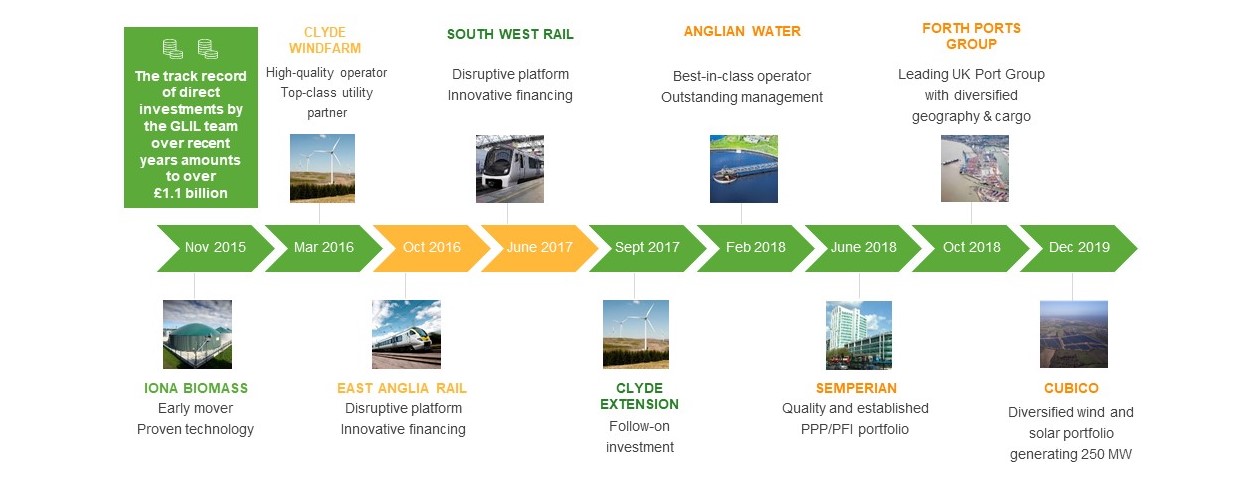
One of GLIL’s earliest transactions was the purchase of a 21.7 percent (£150 million) stake in Clyde Windfarm. At the time of investment, Clyde had 152 turbines and a further 54 more powerful turbines under construction. The new turbines became fully operational in September 2017, and at this point, GLIL invested a further £118 million. Clyde now has a total generation capacity of 522MW, making it one of the largest on shore wind farms in Europe.
More information can be found on the GLIL website.
The aim of the portfolio is to gain cost effective, diversified exposure to property development assets located predominantly in the North West of England and with a clear emphasis on Greater Manchester. Also, to add value to the economy of the North West through property development to generate employment, improve long term employment prospects and generally contribute to the overall development of the local economy. The target size for the mandate is three per cent of the main fund value.
We have an investment mandate for the Impact Portfolio to gain cost effective, diversified exposure to impact investments located predominantly in the North West of England with a focus on Greater Manchester. The impact themes of the portfolio are primarily Jobs and Place. The target size for the mandate is 2 per cent of the main fund value.
Gresham House and Bridges are two of the external fund managers within this portfolio and the videos below showcase the types of investments undertaken and the outcomes we are trying to achieve.
Gresham House Asset Management
Bridges Fund Management
GMPF Investment Holdings
Investment | Policy
Core Belief Statement
This statement sets out GMPF’s key investment beliefs.Investment | Policy
How were investing for climate change
This statement outlines the broad investment principles that govern GMPF’s investment policy.Investment | Policy
Investment Strategy Statement
This statement outlines the broad investment principles that govern GMPF’s investment policy.Investment | Policy
Responsible investment policy
This policy sets out GMPF’s approach to responsible investment and details how the policy is implemented.Investment | Guide
The Good Economy
An independent assessment of the place-based impact of Greater Manchester Pension Fund’s local investment portfolios.
